La sociologie politique chez David Hume: une étude des fondements de la légitimité et des mécanismes de contrôle social
Dr. Bekaddouri houria*1,
Faculty of Social Sciences, Abdelhamid Ibn Badis University, Mostaganem, Algeria
Email: houria.bekadouri.etu@univ-mosta.dz
Orcid: https://orcid.org/signin
Dr. Kerfah Leila2,
Email: l.kerfah@univ-bouira.dz
, Faculty of Social and Human Sciences, Colonel Akli Mohand Oulhadj University, Bouira, Algeria
Received: 05/03/2026 Accepted: 01/07/2026 Published: 10/09/2026
Abstract:
Legitimacy and social control in David Hume’s political thought do not originate in transcendental decrees or rationalist covenants, but in the empirical coordination of human belief and habit. This paper investigates how Hume accounts for sovereign authority in the absence of original consent, resolving the paradox of the few commanding the many. Through an analysis of Book III of A Treatise of Human Nature and key political essays, the study deconstructs the tripartite architecture of “opinion”—encompassing perceived utility, historical precedent, and property security—as the sole foundation of governing power. Furthermore, it details the institutional mechanisms of social control, showing how civil magistrates neutralize humanity’s innate cognitive myopia (narrowness of soul) through regularized coercion, custom, and the rule of law. Employing an institutional feedback model and comparative analytical matrices, the research demonstrates that Hume replaces deductive contractarianism with an observational political sociology that explains civic compliance and constitutional stability in modern states.
Keywords: David Hume; Political Sociology; Foundations of Legitimacy; Social Control; Artificial Conventions.
Résumé:
Chez David Hume, la légitimité et le contrôle social ne procèdent ni d’injonctions transcendantes ni de contrats rationalistes, mais de la coordination empirique des croyances et des habitudes humaines. Cet article examine la manière dont Hume justifie l’autorité souveraine en l’absence de tout consentement originel, résolvant ainsi le paradoxe du gouvernement du grand nombre par le petit nombre. À travers l’examen du Livre III du Traité de la nature humaine et de ses principaux essais politiques, l’étude déconstruit l’architecture tripartite de l’« opinion » — englobant l’utilité perçue, le précédent historique et la sécurité de la propriété — en tant que fondement exclusif du pouvoir étatique. De surcroît, elle détaille les mécanismes institutionnels de régulation sociale, montrant comment les magistrats neutralisent la myopie cognitive humaine (narrowness of soul) par la contrainte légale, la coutume et la primauté du droit. À l’appui d’un schéma de rétroaction institutionnelle et de matrices comparatives, cette recherche établit que Hume substitue au contractualisme déductif une sociologie politique observationnelle capable d’éclairer la stabilité constitutionnelle moderne.
Mots-clés: David Hume ; sociologie politique ; fondements de la légitimité ; contrôle social ; conventions artificielles.
Introduction:
In the historical evolution of Western political thought, the problem of political legitimacy—the normative justification of sovereign power and the structural basis of mass obedience—has generated persistent conflict between speculative metaphysics and empirical analysis. During the seventeenth and eighteenth centuries, two dominant conceptual paradigms asserted authority over European statecraft: theological absolutism, which anchored political subordination in divine ordination and patriarchal lineage, and voluntaristic contractarianism, which posited that legitimate rule traces exclusively to a primordial covenant executed by autonomous individuals exiting a state of nature. These formulations, articulated across divergent philosophical traditions by Thomas Hobbes, Samuel von Pufendorf, and John Locke, approached the state through a deductive framework that assumed sovereign authority requires an initial, conscious surrender of natural rights.
The Scottish Enlightenment executed a decisive rupture with this deductive voluntarism. Preeminent within this intellectual reorientation was David Hume (1711–1776), who sought to introduce the experimental method of empirical reasoning into moral, historical, and political inquiries. Rather than relying on speculative contracts or transcendental mandates, Hume approached political authority as an empirical social phenomenon. He posited that governance is neither coeval with human social coexistence nor the result of a deliberate, universal covenant. Instead, political institutions represent artificial conventions that emerged gradually to remedy specific cognitive flaws within the human mind and maintain collective order amidst external material scarcity.
Significance of the Study: The significance of this investigation operates across theoretical, methodological, and contemporary institutional levels:
- Theoretical Significance: It repositions Hume not merely as an epistemological skeptic or moral sentimentalist, but as a pioneer of political sociology whose work prefigures modern public choice theory, historical institutionalism, and the sociology of power.
- Methodological Significance: It illuminates Hume’s functionalist and psychological approach to politics, showing how systemic obedience and regime survival can be explained through observational psychology and history without recourse to non-empirical fictions like primordial or tacit consent.
- Contemporary Socio-Legal Relevance: Amid modern crises of democratic legitimacy, polarization, and institutional distrust, Hume’s insight that all governance rests on the sociological management of “opinion” provides a realistic diagnostic framework for analyzing regime durability and civic adherence under constitutional orders.
Problem Statement: Despite extensive scholarship examining Hume’s meta-ethics and epistemology, his political sociology—specifically his integrated theory of how sovereign authority achieves legitimacy without contracts and maintains long-term social control—remains dispersed across his philosophical treatises, political essays, and historical narratives. This fragmentation raises a fundamental research question:
How does David Hume dismantle rationalist contractarianism and theological authoritarianism to formulate an empirical political sociology, and through what precise sociopsychological mechanisms does his framework explain the reproduction of legitimate authority and social control?
Subordinate research questions emerge:
- What cognitive limits, psychological passions, and material conditions compel the historical transition from stateless communal bands to institutionalized magistracies?
- How does Hume’s sociological triad of “opinion” (interest, right to power, right to property) resolve the fundamental paradox of the few governing the many?
- Through what institutional and customary dynamics does the civil magistrate correct humanity’s short-term temporal discounting (“narrowness of soul”) to maintain civic peace?
Hypotheses:
- Primary Hypothesis: David Hume de-sacralizes and de-contractualizes political authority by demonstrating that political legitimacy is an emergent artificial convention sustained entirely by sociopsychological habits, perceived mutual utility, and the collective “opinion” of the governed.
- Secondary Hypotheses: The study advances two secondary hypotheses. First, social control operates primarily through the unconscious internalization of custom, imaginative sympathy, and temporal habituation, rather than through persistent sovereign violence. Second, the civil magistracy functions as an institutional counterweight specifically designed to offset humanity’s innate cognitive preference for immediate and contiguous advantages over long-term stability.
Research Objectives:
- To delineate Hume’s empirical anthropology regarding human passions, cognitive myopia, and the socio-historical genesis of civil government.
- To deconstruct Hume’s doctrine of “opinion” as the foundational source of political legitimacy, examining its constituent dimensions: interest, right to power, and right to property.
- To evaluate the operative machinery of social control in Hume’s institutional theory, showing how civil magistrates regulate property, enforce laws, and protect civic liberty under the rule of law.
- To contrast Hume’s political realism with classical contractarian doctrines and highlight its enduring value for modern constitutionalism.
Methodological Framework: This research utilizes a three-dimensional qualitative methodology:
- The Analytical-Textual Method: Conducting rigorous textual analysis across primary texts, focusing on Book III of A Treatise of Human Nature (1739–1740), the political arguments in Essays, Moral, Political, and Literary (1777), and institutional observations in The History of England (1754–1762).
- The Conceptual-Reconstructive Method: Synthesizing Hume’s psychological concepts (sympathy, belief, convention, habituation, and “narrowness of soul”) into a coherent sociological model of state power and compliance.
- The Comparative-Historical Method: Evaluating Humean political theory against seventeenth- and eighteenth-century natural jurisprudence (Hobbes and Locke) and contextualizing his insights within the post-1688 British constitutional framework.
Literature Review and Critical Assessment: Contemporary academic literature addressing Hume’s political thought is generally divided into three major interpretive traditions:
- The Contractarian / Anti-Contractarian Interpretive Debate: Commentators such as Duncan Forbes (Hume’s Philosophical Politics, 1975)[1] and David Gauthier (David Hume, Contractarian, 1979)[2] focused on determining whether Hume’s utilitarian conventions serve as an alternative contractarian theory or a categorical rejection of contractarian thought. Critique: This debate tends to treat Hume’s arguments as abstract formal logic, often overlooking the socio-historical dynamics through which actual states cultivate daily obedience across diverse populations.
- The Natural Jurisprudence and Institutionalist Tradition: Scholars such as Knud Haakonssen (The Science of a Legislator, 1981)[3] and Frederick G. Whelan (Order and Artifice in Hume’s Political Philosophy, 1985)[4] underscored the technical legal architecture of Hume’s artificial virtues. Critique: While explaining the legal mechanics of property and contracts, these analyses often underemphasize the emotional and imaginative forces—such as veneration of antiquity and civic myths—that stabilize political institutions over generations.
- The Ideological Realism and Secularization Tradition: Donald W. Livingston (Hume’s Philosophy of Common Life, 1984)[5] and Paul Russell (The Riddle of Hume’s Treatise, 2008)[6] framed Hume’s political writings as a secular counterweight to theological and ideological fanaticism. Critique: While effectively detailing Hume’s critique of divine right, these studies rarely analyze the specific administrative and judicial mechanisms civil magistrates utilize to secure structural compliance.
The present study bridges these perspectives by providing an integrated socio-political framework that connects Hume’s cognitive anthropology directly to the administrative and customary instruments of social control.
Structural Division of the Study: To address the research questions systematically, the study is structured into three numbered analytical sections:
- The Anthropological Genesis of Political Order: From Passion to Convention: Explores cognitive myopia, the emergence of justice, and the socio-economic evolution toward centralized civil authority.
- The Architecture of Legitimacy: The Primacy of Opinion: Analyzes the sociological paradox of governance, the tripartite structure of opinion, and Hume’s critique of contractarian voluntarism.
- The Machinery of Social Control: Custom, Coercion, and the Rule of Law: Examines the institutional role of magistrates, the psychological economy of custom and habit, and the preservation of liberty within constitutional governance.
1. The Anthropological Genesis of Political Order: From Passion to Convention
Prior to the establishment of coercive state apparatuses, political institutions develop out of humanity’s effort to manage destabilizing psychological drives and resource constraints through artificial conventions of justice.
1.1. Cognitive Bias, the “Narrowness of Soul,” and the Need for Justice
In Book III, Part II of A Treatise of Human Nature, David Hume argues that human survival depends on social association, which multiplies labor capacity, enables specialization, and provides mutual defense.[7]However, human psychology exhibits an intrinsic cognitive vulnerability: an inclination to prioritize immediate, contiguous goods over distant, systemic benefits. Hume defines this cognitive bias as the “narrowness of soul”:
Temporal Bias (Immediate Passion)⟶Erosion of Mutual Trust⟶Social Destabilization⟶Institutional Intervention
Hume demonstrates that when external possessions are unstable, easily transferred, and scarce, natural passions lead individuals to pursue immediate self-interest, dissolving cooperative community bonds:
“This natural infirmity I may frame into a general proposition, that men are always, in great measure, directed by their imagination, and but little by their reason; and that they prefer whatever is present to whatever is distant and remote… You may satisfy yourself of the truth of this proposition by the most obvious and common experiences.”[8]
Because this cognitive tendency is rooted in human nature, it cannot be eliminated through moralizing or rational discourse. Instead, human societies develop artificial virtues—specifically the three foundational conventions of justice: the stability of possession, the transference of property by consent, and the performance of promises.[9]
Figure 1: Structural Feedback Cycle of Cognitive Myopia and Institutional Adaptation
Source: Elaborated by the authors based on Hume’s philosophical works.
1.2. The Historical Transition from Stateless Society to Political Governance
Hume rejects the contractarian assumption that civil government is coeval with human community. In his essay Of the Origin of Government, he shows that small, primitive communities can maintain social harmony for generations without magistrates or written statutes.[10] In closely knit settings, primary associations—such as the family and the clan—regulate conduct through transparency, immediate social disapproval, and natural empathy.
The structural demand for institutional governance emerges only when historical thresholds alter the scale of human interaction:
- Economic Expansion and Anonymous Exchange: As commercial interaction moves beyond localized networks, anonymous transactions weaken the regulatory power of informal social shame, increasing incentives to breach agreements.[11]
- Military Organization and External Warfare: Enduring tribal warfare demands unified command. The war leader who exercises temporary authority during military conflict often translates that status into peacetime civil administration, conditioning communities to hierarchy and centralized command.[12]
Consequently, political governance originates not from deliberate constitutional assemblies, but from institutional adaptations driven by military conflict and economic complexity.
2. The Architecture of Legitimacy: The Primacy of Opinion
Legitimate authority relies neither on superior physical strength nor on transcendent divine ordination, but on the collective sociopsychological consensus of the governed.
2.1. The Paradox of Authority: The Few Governed by the Many
In Of the First Principles of Government, Hume highlights a core sociological puzzle: the physical vulnerability of rulers relative to the ruled.[13]Across all political formations—from despotic regimes to democratic states—physical force rests with the population:
“Nothing appears more surprising to those, who consider human affairs with a philosophical eye, than the easiness with which the many are governed by the few; and the implicit submission, with which men resign their own sentiments and passions to those of their rulers. When we enquire by what means this wonder is effected, we shall find, that, as Force is always on the side of the governed, the governors have nothing to support them but opinion. It is therefore, on opinion only that government is founded; and this maxim extends to the most despotic and most military governments, as well as to the most free and most popular.”[14]
This formulation challenges purely coercive interpretations of state power. Even an authoritarian ruler retains control only because military officers, administrative agents, and internal enforcers share an opinion that justifies obeying commands[15]. Coercive force is not an autonomous physical entity; it is the product of coordinated psychological belief.
Table 1: Typology and Dynamic Functions of Political “Opinion” in Humean Theory
| Dimension of Opinion | Cognitive and Social Foundation | Operational Mechanism in Society | Institutional Impact on Governance |
| Opinion of Interest | Calculation of temporal utility; awareness that order prevents social chaos | Pragmatic compliance based on material security and commercial predictability | Fosters rational civic compliance across productive and commercial classes |
| Opinion of Right to Power | Deference to established tradition, long-standing lineage, and customary precedence | Habitual psychological veneration of historical authority and lineage | Prevents rapid rebellions by sanctifying institutional longevity |
| Opinion of Right to Property | Legal consensus that established rules of ownership and inheritance must remain inviolate | Moral expectation that judicial institutions will protect legal possessions | Secures elite cooperation and economic investment across generations |
Source: Elaborated by the authors based on Hume’s philosophical works.
2.2. The Deconstruction of Social Contract Theory
In Of the Original Contract (1748), Hume challenges the Lockean model of political obligation.[16]Locke argued that legitimate authority derives from the consent of free individuals, and that ongoing political allegiance is grounded in tacit consent granted by living within a territory or inheriting property under its laws.
Hume refutes this voluntaristic position through three empirical arguments:
- The Historical Critique: Existing governments trace their origins to military conquest, usurpation, or dynastic succession. History reveals no historical instance where an egalitarian assembly established a state through universal, voluntary agreement.[17]
- The Epistemological Critique: Meaningful consent requires conscious deliberation and the practical freedom to decline obligations. The broad majority of populations—peasants, laborers, and artisans—are born into political systems without consultation, viewing allegiance to their sovereign as an inherited social reality from birth.[18]
- The Empirical Fallacy of Tacit Consent: Locke’s thesis that residency signifies tacit consent is rejected by Hume as an empirical absurdity:
“Can we seriously say, that a poor peasant or artizan has a free choice to leave his country, when he knows no foreign language or manners, and lives from day to day, by the small wages which he acquires? We may as well assert, that a man, by remaining in a vessel, freely consents to the dominion of the master; though he was carried on board while asleep, and must leap into the ocean, and perish, the moment he leaves her.”[19]
Hume concludes that anchoring political allegiance in contractual promises creates an explanatory regress: why are citizens obligated to keep promises? For Hume, the obligation to keep promises and the obligation of political allegiance (allegiance to magistrates) represent two distinct artificial virtues, both justified by the same foundation: the preservation of public utility and social stability.[20]
3. The Machinery of Social Control: Custom, Coercion, and the Rule of Law
Preserving institutional stability requires turning fragile utilitarian calculations into habitual civic compliance, regulated by impersonal legal codes and enforceable institutional sanctions.
3.1. The Role of the Magistrate as an Institutional Solution
To solve humanity’s systemic “narrowness of soul,” Hume proposes an institutional remedy rather than moral transformation: society cannot alter basic human nature; it can only reconfigure the human situation.[21]
This situational adjustment is achieved through the institution of civil magistrates:
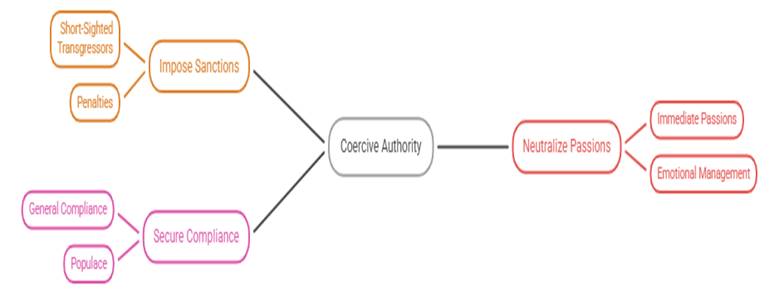
Source: Elaborated by the authors based on Hume’s philosophical works.
Magistrates occupy a distinct institutional role: because their social standing, official income, and honors depend directly on maintaining public order, their short-term personal interests align with the impartial enforcement of justice.[22]They have no structural incentive to tolerate violence or theft, as disorder undermines their own administrative authority. By penalizing immediate violations, the magistracy leads citizens to recognize their long-term societal obligations.
Table 2: Structural Paradigms of Political Authority: Hobbes, Locke, and Hume
| Analytical Metric | Thomas Hobbes | John Locke | David Hume |
| Philosophical Paradigm | Authoritarian Absolutism | Liberal Contractarianism | Empirical Political Sociology |
| State Emergence | Unilateral covenant to escape existential terror | Bilateral fiduciary contract to secure natural rights | Evolutionary convention born of conflict and commerce |
| Foundational Legitimacy | Absolute power maintaining bodily survival | Explicit and tacit consent of property owners | Societal utility confirmed through collective “opinion” |
| Conception of Property | Created entirely by sovereign fiat | Pre-political natural right rooted in individual labor | Artificial convention designed to mitigate physical scarcity |
| Primary Social Control | Fear of sovereign punishment | Moral commitment to covenants and executive law | Custom, habituation, and judicial enforcement |
| Grounds for Resistance | Direct threats to individual biological survival | Systematic breach of contract by executive power | Severe tyranny causing greater evil than rebellion itself |
Source: Elaborated by the authors based on Hume’s philosophical works.
3.2. Custom, Habituation, and the Subconscious Reproduction of Order
While state coercion serves as the ultimate guarantee of legal compliance, Hume stresses that day-to-day social control is maintained through the quiet influence of custom and habit.[23]
In his political psychology, Hume notes that human minds naturally associate legitimacy with institutions that have endured over time. Longstanding authority transforms initial force into recognized right:
- The Temporal Sanctification of Authority: Institutional duration fosters perceived legitimacy. Regimes that originated in historical violence or conquest acquire normative authority across generations because social expectation associates obedience to that office with peace and continuity.[24]
- The Economy of Coercive Force: A government relying exclusively on physical intimidation is structurally fragile and costly to maintain. Enduring regimes minimize the visible use of coercive violence, employing it primarily at institutional margins. The general population complies with daily laws—such as taxation, contract compliance, and administrative orders—not out of constant fear of punishment, but through habitual patterns of deference internalized from childhood.[25]
3.3. The Balance Between Authority and Liberty in Constitutional Governance
Hume observes that political sociology must account for the ongoing dialectic between sovereign authority and individual liberty. In Of the Origin of Government, he identifies this structural tension:
“In all governments, there is a perpetual intestine struggle, open or secret, betwixt Authority and Liberty; and neither of them can ever absolutely prevail. A great sacrifice of liberty must necessarily be made in every government; yet even the authority, which must attend this sacrifice, ought never to become quite uncontrollable and absolute.”[26]
To protect the state from degenerating into arbitrary tyranny, Hume argues for a constitutional system based on the rule of law rather than arbitrary individual will. In regularized constitutional frameworks (such as the system Hume observed developing in eighteenth-century Britain), authority is depersonalized. Laws must be general, uniform, publicly declared, and predictable.[27]When institutional systems meet these criteria, social control functions not as a tool of private domination, but as an impersonal structure that allows commerce, science, and civil society to develop safely.
- Conclusion
David Hume’s investigation into the foundations of legitimacy and the mechanisms of social control represents a transformative contribution to modern political thought. By stripping the state of theological mysticism and contractual fictions, Hume established an empirical political sociology that approaches institutional power through historical and psychological realism.
Hume shows that civil society is sustained not by ancient voluntary promises, but by the complex, evolving architecture of human opinion. While physical force will always rest with the governed multitude, political stability is achieved because institutions cultivate opinions of interest and right, habituating citizens into unreflective civic compliance. The civil magistrate does not alter the fundamental traits of human psychology; rather, by structuring social environments through the predictable administration of justice, the magistracy aligns immediate self-interest with general public peace. Hume’s functionalist model shows that political order is ultimately an issue of sociological equilibrium—a balance achieved when custom, utility, and constitutional rule of law interact to maintain social stability.
4.1. Findings
- Hume empirically disproves the social contract tradition, showing that states historically trace to violent conquest or military necessity, and that civic obedience is sustained by inherited habit rather than explicit or tacit consent.
- Sovereign power is demonstrated to be a sociopsychological construct; because physical force resides with the governed, political authority persists only as long as rulers maintain the collective “opinion of interest” and “opinion of right.”
- The primary structural purpose of the civil magistrate is to counteract human temporal discounting (“narrowness of soul”), aligning the immediate interests of rulers with the societal utility of enforcing justice.
- Enduring political control is maintained not through relentless physical coercion, but through the accumulation of customary habit, which gradually transforms raw power into unquestioned authority.
4.2. Recommendations
- Modern states should prioritize the absolute uniformity and predictability of legal codes, insulating public administration from personal discretion to safeguard the vital “opinion of right.”
- Regimes seeking institutional stability should cultivate the “opinion of interest” by designing economic and social policies that visibly distribute security, legal protections, and economic opportunity across all social classes.
- Legislative and institutional reforms should respect constitutional continuity, avoiding abrupt structural realignments that fracture established habits of civic deference.
- Contemporary jurisprudence should draw on Hume’s psychological insights, structuring legal frameworks that make compliance immediately advantageous rather than relying entirely on reactive punitive measures.
4.3. Future Research Horizons
Future studies in Humean political sociology should examine the operational validity of Hume’s concept of “opinion” within algorithmic and digital communication environments. Inquiries should investigate how decentralized media networks and rapid digital information flows affect traditional mechanisms of civic habituation, altering the stability of the “opinion of right” in contemporary democracies. Additionally, comparative analyses should assess how developing and post-revolutionary states, which lack long-standing institutional traditions, can generate political legitimacy without resorting to authoritarian coercion, testing whether Hume’s functional balance between authority and liberty can inform democratic consolidation today.
- References
- Baier, A. C. A progress of sentiments: Reflections on Hume’s Treatise. Harvard University Press, 1991. https://doi.org/10.2307/j.ctv1g247vd
- Cohon, R. Hume’s morality: Feeling and fabrication. Oxford University Press, 2008. https://doi.org/10.1093/acprof:oso/9780199268443.001.0001
- Forbes, D. Hume’s philosophical politics. Cambridge University Press, 1975. https://doi.org/10.1017/CBO9780511560064
- Garrett, D. Cognition and commitment in Hume’s philosophy. Oxford University Press, 1997. https://doi.org/10.1093/0195105658.001.0001
- Gauthier, D. David Hume, contractarian. The Philosophical Review, 88(1), 3–38, 1979. https://doi.org/10.2307/2184777
- Haakonssen, K. The science of a legislator: The natural jurisprudence of David Hume and Adam Smith. Cambridge University Press, 1981. https://doi.org/10.1017/CBO9780511628283
- Hume, D. A treatise of human nature (L. A. Selby-Bigge & P. H. Nidditch, Eds.; 2nd ed.). Clarendon Press (Original work published 1739–1740), 1978. https://davidhume.org/texts/t/
- Hume, D. An enquiry concerning the principles of morals (T. L. Beauchamp, Ed.). Oxford University Press (Original work published 1751), 1998. https://davidhume.org/texts/m/
- Hume, D. Essays, moral, political, and literary (E. F. Miller, Ed.). Liberty Fund (Original work published 1777), 1987. https://oll.libertyfund.org/titles/hume-essays-moral-political-literary-lf-ed
- Hume, D. The history of England: From the invasion of Julius Caesar to the revolution in 1688 (W. B. Todd, Ed.; 6 vols.). Liberty Fund (Original work published 1754–1762), 1983.